Most AI assistants wait for you to ask a question. Anthropic wants its next assistant to do something different: notice what needs your attention, start working on tasks, and contact you when a decision is required.
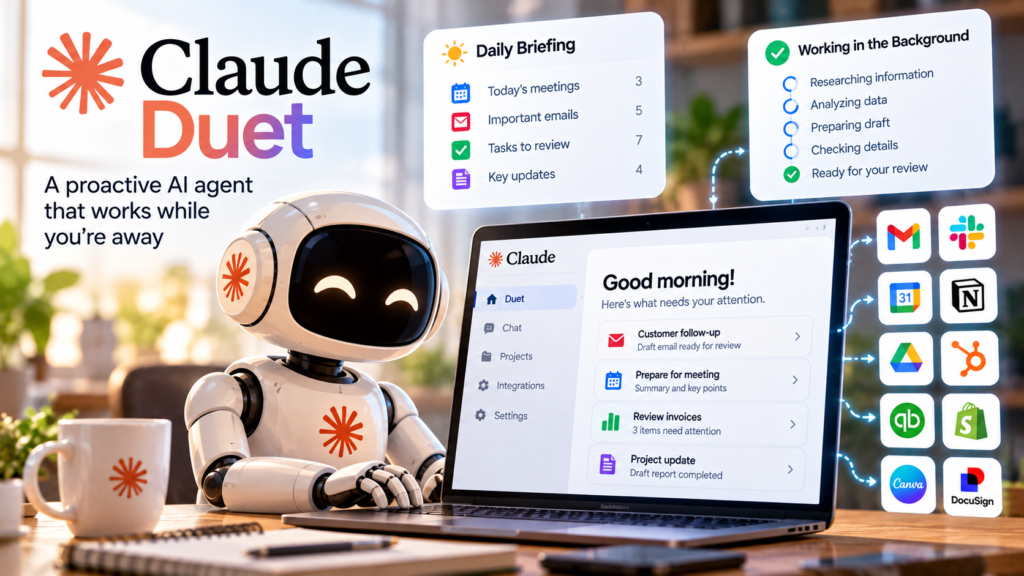
On October 21, 2026, Anthropic introduced Claude Duet, a new AI agent designed to help professionals and small-business owners manage their workload. Rather than functioning like a conventional chatbot, Duet can review connected apps, prepare a daily briefing, work on assigned tasks in the background, and ask for approval before taking consequential actions.
The product is currently available as a research preview through a waitlist for eligible Claude Pro and Max subscribers in the United States. It is available through standalone apps for iOS and Android and on the web at Claude.com.
The announcement signals a broader shift in AI productivity: moving from assistants that answer questions to agents that help carry work through to completion.
What Is Claude Duet?
Claude Duet is a proactive AI agent built around Anthropic’s Claude Opus 5.5 model. It is designed to help users manage information, prioritize tasks, and complete work across connected applications.
The main difference between Duet and a traditional chatbot is how the interaction begins.
With a conventional assistant, you open the app, write a prompt, and wait for an answer. Duet is designed to take more initiative. It can prepare a morning briefing, identify items that may need attention, and continue working on tasks after you leave the app.
Anthropic says the product is intended for professionals and small-business owners who have more responsibilities than they can easily keep track of.
For example, a business owner might use Duet to review outstanding invoices, prepare customer follow-up emails, or consolidate information from several business applications. A project manager might ask it to research a topic, build a dashboard, or prepare a forecast.
These are not simply question-and-answer interactions. They are tasks that may require multiple steps and information from different sources.
Anthropic explains the product’s capabilities in its official announcement, Introducing Claude Duet.
How Claude Duet Works
Claude Duet combines proactive notifications, connected applications, and background task execution into a single assistant.
1. It sends a daily briefing
Each morning, Duet can provide a short briefing covering important items found across connected applications.
Instead of opening email, chat, calendars, and business tools separately, users can start with a consolidated view of matters that may need their attention.
For instance, the briefing might highlight a customer meeting, an unanswered message, or an invoice that needs follow-up, depending on the connected services and available information.
The objective is to reduce the time spent searching for updates before beginning the workday.
2. It checks connected apps throughout the day
Duet can continue checking connected accounts and notify users when something appears to require attention.
However, Anthropic says these checks occur every few hours rather than continuously. This approach helps manage usage limits, but it also means the agent may not identify an urgent development immediately.
Users can provide instructions about what they want monitored and how frequently they want to hear about it.
This makes Duet different from a simple notification system: it is intended to interpret information and help determine which items deserve attention.
3. It continues working in the background
One of Duet’s central features is its ability to work when the user steps away.
Anthropic says the agent operates using a cloud-hosted virtual machine with its own browser. Tasks therefore do not require the user’s phone or computer to remain switched on.
A user could ask Duet to research a subject, prepare a financial forecast, develop a dashboard, or work on a web application. The agent can continue through the necessary steps and notify the user when it has finished or needs a decision.
This is particularly relevant for tasks that involve several stages rather than a single response.
For readers interested in related productivity techniques, our guide to creating documents with voice in Google Docs explores another way to reduce the manual effort involved in capturing ideas and producing written work.
What Tasks Can Claude Duet Handle?
Anthropic says Duet can work with more than 6,000 connectors and plugins available through the Claude Marketplace. The actual services available depend on the integration and account setup.
Examples described by Anthropic include:
- Email and communication: Find relevant Gmail messages and Slack discussions, then help prepare replies.
- Accounting: Review information from supported services such as QuickBooks or Stripe and draft invoice reminders.
- Human resources: Help prepare payroll information using supported Gusto integrations.
- Sales: Use customer and deal information from HubSpot to draft follow-up emails.
- Marketing: Help turn a product launch into a social media campaign using Canva.
- Documents and agreements: Prepare agreements for review and signature through supported DocuSign workflows.
- E-commerce: Help manage Shopify store tasks, with some richer editing capabilities planned for a later release.
The range of potential applications is significant, but a connector does not mean every task can be completed without human involvement. Permissions, service capabilities, account restrictions, and approval requirements still apply.
For small businesses, the appeal is straightforward: an agent could help coordinate repetitive administrative work across several services without requiring the owner to manage every step manually.
Claude Duet Still Requires Human Approval for Important Actions
An AI agent that can access email, business documents, and financial tools introduces risks that do not arise in the same way with a basic chatbot.
A mistaken answer is one problem. An agent that sends the answer to a customer, deletes a document, or makes a payment creates a different level of risk.
Anthropic says Claude Duet must show users what it intends to do and obtain approval before consequential actions such as sending messages, making payments, signing documents, or deleting information.
The company also identifies certain actions that remain prohibited, including trading securities and transferring money between accounts.
Anthropic says Duet incorporates safeguards against malicious instructions hidden in webpages or other content, and that its security infrastructure has undergone adversarial testing, including an external penetration test.
These protections matter because an agent that reads information from multiple applications may encounter instructions that were not written by the user. A malicious email or webpage, for example, could attempt to manipulate the agent into disclosing sensitive information or taking an unauthorized action.
Anthropic has published further details in Claude Duet: Safety, Privacy, and Security.
Nevertheless, users should treat these controls as safeguards, not guarantees that errors or security incidents are impossible. Review proposed actions carefully, limit access to unnecessary accounts, and avoid granting an AI agent broader permissions than its work requires.
Our coverage of the growing AI backlash discusses the broader concerns surrounding AI adoption, including questions about trust, control, and its effects on work.
Who Can Use Claude Duet?
Claude Duet is not yet a generally available product.
For the research preview announced on October 21, 2026, Anthropic is starting with eligible Claude Pro and Max subscribers in the United States through a waitlist.
The product is available through:
- A standalone iOS app
- A standalone Android app
- The web interface at Claude.com
Users can join the waitlist through the official Claude Duet page.
Anthropic has not announced general availability for all users in the initial announcement. Businesses using Team or Enterprise plans should check Anthropic’s latest product documentation rather than assume their accounts are eligible.
The preview does not require a separate Duet subscription fee for eligible Pro and Max users. However, Duet shares the usage limits of the existing Claude plan. Background checks and larger tasks also consume usage, so using the agent may cause users to reach their limits sooner than when they only chat with Claude.
That is an important consideration for anyone planning to rely on Duet for frequent or complex workflows.
Claude Duet vs. a Traditional AI Chatbot
The distinction comes down to initiative and execution.
A traditional chatbot primarily responds to prompts. It can summarize a document, draft an email, or explain a spreadsheet, but users usually need to initiate each interaction and move the result into the next application themselves.
Claude Duet is designed to take on more of that coordination. It can surface relevant information without waiting for a prompt, continue working in the background, and perform multi-step tasks through connected tools.
Consider the difference in a customer follow-up workflow.
With a conventional chatbot, a salesperson might find the meeting notes, paste them into the assistant, request an email draft, review the result, and then send it manually.
With Duet, the agent may be able to retrieve relevant information from connected services, prepare the draft, and present it for approval. The user still remains responsible for reviewing the message before it is sent.
That distinction could save time, particularly for recurring administrative work.
However, autonomous execution does not automatically mean better results. Users still need to check factual accuracy, evaluate the quality of the output, and ensure that automated actions comply with company policies.
What Claude Duet Means for Workplace Productivity
Claude Duet arrives as AI companies increasingly compete to build agents that can perform work rather than simply generate text.
For employees, this could mean less time spent managing notifications, locating information, and coordinating repetitive tasks. For small businesses, it could provide a way to handle some administrative work without adding another layer of manual processes.
But the practical benefits will depend on three factors.
First, the agent must correctly identify which information matters. A daily briefing that highlights irrelevant messages will not save much time.
Second, its integrations must support the tasks users actually need. A long connector list is useful only when the relevant services and actions are available.
Third, the agent must perform reliably enough that checking and correcting its work does not erase the time saved.
Organizations should evaluate these systems using real outcomes, such as hours saved, task completion rates, error rates, and the amount of human review required.
Privacy and access controls also deserve attention. An agent connected to business email, financial tools, and customer records needs carefully defined permissions and a clear approval process.
Final Thoughts
Anthropic’s Claude Duet is an attempt to make AI assistance more proactive. Rather than waiting for users to ask questions, it is designed to identify work that needs attention, continue tasks in the background, and request approval before taking consequential actions.
Its combination of daily briefings, connected applications, and background execution could be useful for professionals and small-business owners who spend significant time coordinating information across different tools.
For now, the product remains in a limited research preview, with access restricted to eligible US Claude Pro and Max subscribers on the waitlist. Its shared usage limits and early-stage capabilities are also important considerations.
The broader direction is clear: AI assistants are moving beyond answering questions toward helping people complete multi-step work. Whether Claude Duet delivers meaningful productivity gains will depend on how reliably it handles those tasks while keeping users in control.