
Artificial intelligence is becoming more capable of doing far more than answering questions. Modern AI systems can write software, analyze business information, operate digital tools, conduct research, and execute complex workflows with increasing levels of autonomy.
As these capabilities expand, an important question becomes harder to ignore: How should an AI system behave when following an instruction literally is not necessarily the right thing to do?
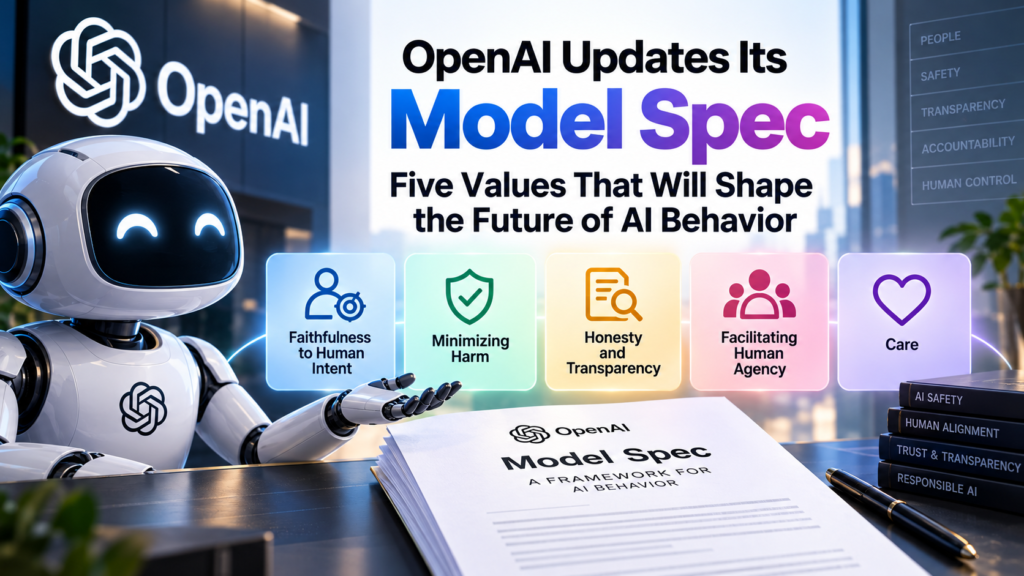
OpenAI is addressing this challenge through an updated version of its Model Spec, published on October 29, 2026. The revision reorganizes its public guidance for AI behavior around five fundamental values: faithfulness to human intent, minimizing harm, honesty and transparency, human agency, and care.
The update is particularly significant because it emphasizes that AI systems must understand the intentions and values behind instructions, not simply interpret the words they receive.
For developers, businesses, and everyday AI users, this represents an important development in how AI companies approach alignment, safety, and responsible automation.
Here is what changed, how the five values work, and what the update could mean for the future of AI.
What Is the OpenAI Model Spec?
The OpenAI Model Spec is a public document describing how OpenAI wants its models to behave.
It establishes behavioral principles that guide how models respond to instructions, handle conflicting requests, communicate uncertainty, manage risks, and interact with people.
Think of it as a behavioral framework for AI systems rather than a technical manual explaining how a model is trained.
The document helps establish expectations for different parties:
- OpenAI defines the behavioral framework and establishes its boundaries.
- Developers direct how AI models operate within their applications.
- Users provide instructions and determine what they want the models to accomplish, subject to applicable constraints.
The Model Spec also establishes a hierarchy for resolving conflicting instructions. This matters because an AI system may receive instructions from multiple sources that do not always agree.
For example, a user might ask an AI assistant to perform an action that conflicts with an application’s security requirements. The model needs a framework for determining which instruction takes precedence.
The updated Model Spec makes these underlying principles more explicit.
You can read the complete document on the official OpenAI Model Spec website.
The Five Core Values Behind OpenAI’s Updated Model Spec
The October 29 revision reorganizes the behavioral framework around five values.
These are not five independent features or new AI capabilities. They are broad principles intended to guide how models make decisions across different situations.
1. Faithfulness to Human Intent
The first and foundational value is faithfulness to human intent.
OpenAI argues that models should understand what people actually want to accomplish rather than simply follow the literal wording of their instructions.
This distinction becomes increasingly important as AI systems handle more complicated tasks.
Consider a simple example.
A business owner asks an AI assistant:
“Find a way to reduce our monthly software expenses.”
A system that follows the instruction too literally might recommend canceling several subscriptions immediately.
However, some of those subscriptions may support essential business operations.
A more capable assistant should consider the broader objective: reducing unnecessary spending without disrupting important workflows.
It might examine subscription usage, identify overlapping services, estimate potential savings, and present recommendations before suggesting cancellations.
That is the difference between following words and understanding intent.
OpenAI also emphasizes that understanding human intent requires considering context, including relevant conversation history and previously expressed preferences.
However, contextual assumptions should remain open to correction. An AI system should not silently decide what a person wants based on incomplete information.
Why this matters: As AI agents become more autonomous, understanding the objective behind a task becomes increasingly important. An agent that executes instructions without understanding their purpose can produce technically correct but undesirable outcomes.
2. Minimizing Harm
The second value is minimizing harm.
AI systems can affect people, businesses, and digital infrastructure. Their actions may create consequences that extend beyond the immediate conversation.
OpenAI’s updated guidance emphasizes respecting safety boundaries and considering foreseeable consequences.
For example, an AI agent managing a company’s digital operations might be asked to clean up unnecessary files.
A poorly controlled agent could delete important records, remove business-critical documents, or disrupt a shared workspace.
A system designed around harm minimization should recognize the potential consequences, respect applicable restrictions, and handle risky actions appropriately.
This principle becomes especially important in areas such as:
- Cybersecurity and software development.
- Financial and business operations.
- Healthcare information.
- Personal data management.
- Automated communications.
- Digital infrastructure administration.
Minimizing harm does not mean that AI systems should avoid every action involving risk. It means they should recognize meaningful risks and operate within appropriate safety boundaries.
Why this matters: Businesses need AI systems that can perform useful work without introducing unacceptable operational, financial, or security risks.
3. Honesty and Transparency
The third value is honesty and transparency.
An AI system should communicate truthfully about what it knows, what it has done, and where uncertainty exists.
This principle addresses one of the most persistent problems with generative AI: systems can produce convincing answers that are inaccurate, incomplete, or unsupported.
For example, imagine asking an AI assistant to research a company’s financial performance.
A transparent system should distinguish between:
- Figures taken directly from official financial statements.
- Calculations derived from those figures.
- Estimates based on assumptions.
- Information that could not be independently verified.
It should not present an estimate as an audited financial result or claim to have completed research that it has not actually performed.
Transparency also matters when AI systems use external tools.
If an agent cannot access a website, complete a transaction, or verify a particular claim, it should communicate that limitation rather than imply success.
OpenAI’s updated guidance emphasizes helping people understand and evaluate the model’s work.
Why this matters: Trustworthy AI requires more than producing fluent answers. Users need to understand the reliability, limitations, and origins of the information they receive.
4. Facilitating Human Agency
The fourth value is facilitating human agency.
Human agency refers to people’s ability to understand their circumstances, make informed decisions, and act according to their own goals.
OpenAI’s framework emphasizes that AI should strengthen these abilities rather than quietly replace them.
Consider an AI assistant helping someone evaluate different business opportunities.
A useful system can compare costs, estimate potential returns, identify risks, and explain the assumptions behind each option.
However, it should not secretly steer the user toward a particular decision or substitute its own objectives for the user’s priorities.
This principle becomes especially relevant when AI systems can take actions independently.
An AI agent might be capable of:
- Sending emails.
- Updating business records.
- Publishing content.
- Changing software configurations.
- Making recommendations based on personal information.
- Executing approved workflows.
Greater autonomy creates a greater need for meaningful human oversight.
OpenAI’s updated Model Spec emphasizes supporting people’s ability to make choices and retain control over consequential decisions.
Why this matters: The objective of useful AI automation should be to increase human capability, not make people dependent on systems they cannot understand or control.
5. Care
The fifth value is care.
OpenAI describes care as paying attention to the circumstances of people affected by an AI system’s actions and following relevant social and professional norms.
This goes beyond simply being polite or using friendly language.
An AI system may produce an accurate answer that is nevertheless inappropriate because it ignores the situation in which the answer will be used.
For example, an assistant helping a business communicate with an unhappy customer should consider the customer’s circumstances, the company’s obligations, and the potential consequences of the response.
Similarly, an AI system helping someone prepare an important document should prioritize accuracy, clarity, and reliability rather than merely producing something that looks complete.
Care also includes considering people who may be affected indirectly by an AI-assisted decision.
Why this matters: AI systems increasingly operate in environments involving customers, employees, clients, and other stakeholders. Responsible behavior requires considering those people, not just satisfying the immediate request.
What Actually Changed in the October 29 Update?
The five values provide the conceptual foundation, but the revision also introduces several practical changes to the Model Spec.
| Area | What changed |
|---|---|
| Human intent | Adds a more explicit framework for understanding the intentions behind instructions |
| Context | Clarifies how conversations, memories, and contextual information should inform responses |
| Oversight | Strengthens guidance on human supervision and correction |
| Human agency | Adds defaults intended to support users’ ability to make their own decisions |
| Side effects | Expands guidance on considering and communicating the consequences of actions |
| Style guidance | Retires most detailed style instructions, allowing style to adapt to user preferences and context |
| Terminology | Uses “GPT” instead of “the assistant” throughout the updated Spec |
One particularly important addition concerns context.
An AI system should not interpret every instruction in isolation when relevant information is available from the surrounding conversation.
For example, if a user previously explained that a business must operate within a strict budget, an assistant helping evaluate new software should consider that constraint when making recommendations.
However, it should also recognize that preferences can change and allow users to correct outdated assumptions.
Another important change concerns style.
OpenAI is retiring much of the detailed style guidance in favor of more adaptable behavior. The intention is to allow communication to reflect user preferences, language, culture, and context while retaining stronger defaults, including objective responses.
The updated document also strengthens guidance around oversight and communicating the side effects of actions.
These changes reflect a broader challenge: increasingly capable AI systems need more than a collection of isolated behavioral rules.
They need to apply underlying principles when encountering situations that their instructions do not explicitly anticipate.
Source: OpenAI’s official explanation of the Model Spec update.
Why the Update Matters as AI Agents Become More Autonomous
The timing of this revision is important.
AI is moving beyond conventional chat interfaces toward systems that can interact with software, access information, and execute multi-step tasks.
These systems are commonly described as AI agents.
An AI chatbot generally responds to questions or instructions. An AI agent can also use tools, inspect information, perform actions, and continue working toward a defined objective.
That difference creates additional challenges.
Imagine an AI agent assigned to manage a company’s customer support operations.
It might need to:
- Read incoming customer messages.
- Identify the underlying problem.
- Retrieve relevant customer information.
- Draft an appropriate response.
- Update the customer relationship management system.
- Escalate sensitive cases to a human employee.
Each step introduces opportunities for mistakes.
The agent might misunderstand the customer’s request, retrieve incorrect information, expose sensitive data, or update a record incorrectly.
The five values offer a framework for evaluating these situations.
Faithfulness helps the agent understand the task. Harm minimization helps it recognize potential risks. Honesty requires accurate communication. Human agency preserves appropriate oversight. Care ensures that the interests of affected people are considered.
This is why the Model Spec update is relevant beyond ChatGPT.
It addresses challenges that increasingly affect developers building AI-powered products and businesses introducing autonomous workflows.
For more practical examples, explore the Work & Productivity section on AccessioDocs.
What Does This Mean for AI Developers and Businesses?
The updated Model Spec has practical implications for organizations building or deploying AI systems.
For AI developers
Developers need to think beyond prompt engineering.
Writing a detailed instruction is useful, but reliable AI applications also need clear permissions, appropriate safeguards, context management, and ways to review consequential actions.
For example, an AI agent responsible for updating a database should have access only to the records and operations necessary for its assigned task.
Developers should also provide mechanisms for users to inspect actions, correct mistakes, and intervene when needed.
For business owners
Businesses should evaluate AI tools based on more than speed and productivity claims.
Important questions include:
- Can the system explain where its information comes from?
- Does it recognize uncertainty?
- Can users review important actions before execution?
- What information can the system access?
- Can its actions be reversed?
- How does it handle sensitive customer information?
These considerations become particularly important when AI systems are connected to financial software, customer databases, internal documents, or business applications.
For everyday AI users
Users should understand that AI-generated answers are not automatically accurate or complete.
They should verify important information, particularly when dealing with financial, legal, medical, or professional decisions.
It is also important to distinguish between an AI system suggesting an action and actually having permission to perform it.
The more access an AI system receives, the more important it becomes to understand its permissions and limitations.
Businesses exploring AI-powered digital products can find additional practical guidance in the Make Money With AI category on AccessioDocs.
An Important Limitation: The Updated Model Spec Is Not a New AI Model
There is an important distinction that readers should understand.
OpenAI’s October 29 announcement does not introduce a new GPT model or claim that all existing models immediately satisfy every principle in the revised document.
The Model Spec describes the behavior OpenAI is working toward.
In its announcement, OpenAI explicitly acknowledges that its models do not yet fully reflect the updated Spec.
The company also says it is exploring new training methods to help models understand the underlying values and apply the behavioral principles in unfamiliar situations.
OpenAI plans to share further results and lessons from this work in future updates.
This distinction matters because publishing a behavioral framework is not the same as demonstrating that a model consistently follows it.
Actual performance must be evaluated through research, testing, deployment experience, and feedback.
The five values should therefore be understood as intended behavioral commitments rather than a guarantee that every AI interaction will meet those standards.
How Does OpenAI’s Approach Compare With the Broader AI Industry?
OpenAI is not the only AI company exploring ways to define the principles governing its models.
Anthropic, the company behind Claude, has developed its own Constitutional AI approach, using a written set of principles to guide model behavior.
Both approaches recognize that increasingly capable AI systems need guidance that extends beyond individual instructions.
However, their frameworks are not identical.
OpenAI’s updated Model Spec organizes its guidance around five broad values and a hierarchy of instructions.
Anthropic’s constitutional approach uses a separate constitution to articulate principles that guide Claude’s behavior.
The approaches reflect a broader industry challenge: how to build AI systems that remain useful, reliable, and responsive to human direction while operating safely in increasingly complex environments.
For readers interested in other developments from leading AI companies, visit the AI News & Trends section on AccessioDocs.
What Comes Next for AI Alignment?
OpenAI’s revised Model Spec represents an effort to make the reasoning behind its behavioral expectations more explicit.
However, the difficult work is translating those principles into consistent model behavior.
Several questions remain important:
Can AI systems reliably understand human intent?
Natural-language instructions are often incomplete or ambiguous. Models must interpret context without making unjustified assumptions.
Can autonomous agents remain under meaningful human control?
As agents gain access to more tools and business systems, organizations need effective monitoring, permissions, and intervention mechanisms.
Can models be honest about their limitations?
Users need systems that acknowledge uncertainty, distinguish evidence from speculation, and communicate when they cannot complete a task.
Can AI systems balance competing values?
Helping one person may create risks for another. Minimizing harm, respecting autonomy, and following instructions can sometimes involve difficult trade-offs.
How will companies measure progress?
Publishing principles is only the beginning. AI developers need ways to test whether models actually demonstrate the intended behaviors across different situations.
These questions will remain central as AI systems become more capable and are entrusted with increasingly consequential tasks.
Final Thoughts
OpenAI’s updated Model Spec provides a clearer framework for the behavior it wants from increasingly capable AI systems.
Its five values—faithfulness to human intent, minimizing harm, honesty and transparency, facilitating human agency, and care—address important challenges that emerge when AI moves beyond answering questions and begins taking meaningful actions.
For developers, the update highlights the importance of building systems with appropriate permissions, oversight, and transparency.
For businesses, it provides useful criteria for evaluating AI tools and automation systems.
For everyday users, it reinforces the importance of understanding what AI systems can do, what they cannot reliably do, and where human judgment remains essential.
But the most important distinction is between intended behavior and demonstrated performance.
The updated Model Spec describes the standards OpenAI wants its models to meet. Whether those standards are consistently achieved will depend on how effectively they are translated into training, testing, and real-world deployment.
As AI becomes more integrated into everyday work and decision-making, the ability to build systems that are not only capable but also reliable, transparent, and responsive to human intentions will become increasingly important.
Read the full document: OpenAI Model Spec
This article is based on OpenAI’s October 29, 2026 announcement and the published Model Spec. It describes the company’s stated behavioral objectives and does not independently establish that deployed models consistently meet them.
Share this article