What if you could create a digital product once and sell it repeatedly without managing inventory, shipping packages, or manufacturing physical goods?
That is the business model behind digital downloads. With AI tools such as ChatGPT and design software such as Canva, creators can research product ideas, draft descriptions, develop layouts, and prepare digital products more efficiently.
But efficiency alone does not create a profitable business. The real challenge is finding a product people want to buy and making it more useful than the alternatives already available.
A real Etsy seller offers a useful example of how this model works.
A Real Case Study: More Than CA$34,000 in Digital Product Sales
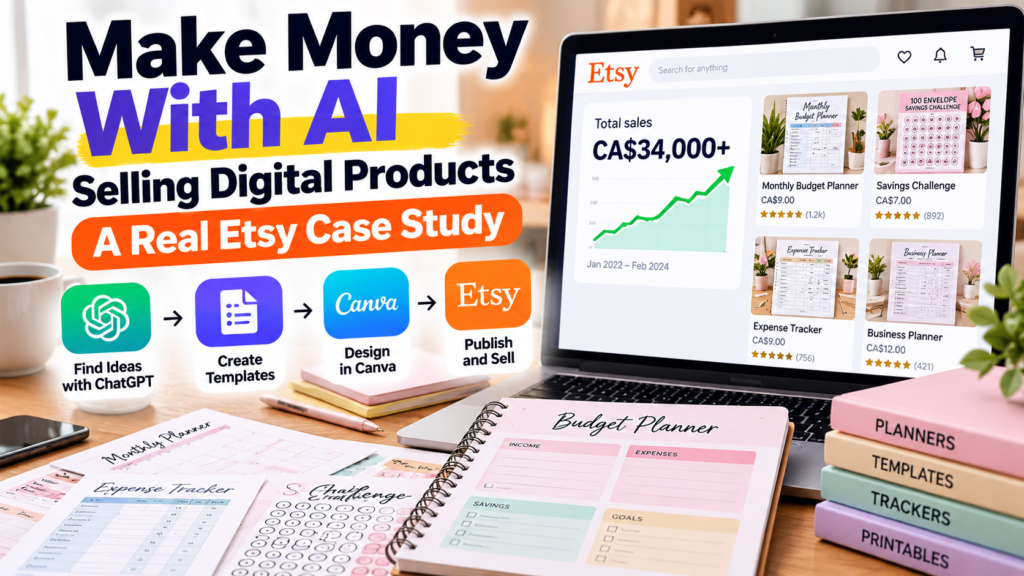
In February 2024, Business Insider profiled Claudine Lam, a telecommunications sales representative in British Columbia, Canada, who built an Etsy business selling digital printables.
Lam started her shop in January 2022 after buying a home and wanting to earn an additional $500 per month. She initially experimented with seasonal printables before shifting toward budgeting templates and savings challenges.
According to the report, she accumulated more than CA$34,000 in sales from January 2022 to early 2024. Business Insider reported reviewing screenshots of her Etsy account to support the sales figure.
The distinction between sales and profit matters. The reported total was revenue, not the amount she kept after marketplace fees, advertising, and other expenses. The report also noted that her best month in 2022 produced CA$2,273 in net profit.
Read the original Business Insider case study about Claudine Lam.
Her business was not built around a single viral product. She gradually developed a catalog of approximately 240 digital products, creating many of them during evenings and weekends.
The key lesson is that a modest side business can grow through a combination of useful products, marketplace discovery, and consistent improvement. AI can assist with parts of that process, but it does not replace the need to understand customers.
How ChatGPT Helped With the Business
Lam used ChatGPT to draft product descriptions, then edited the language to reflect the actual product. She also used Canva to design printable materials.
This is a practical example of using AI to reduce repetitive work rather than expecting AI to run an entire business.
Here are several ways a similar workflow can be applied.
1. Research Products People Already Want
Before creating anything, identify a specific customer problem.
For example, potential product categories include:
- Monthly budget planners
- Savings challenge trackers
- Small-business expense organizers
- Printable household planners
- Social media content calendars
- Client onboarding templates
These are product ideas to investigate, not guaranteed profitable niches.
Research marketplace search suggestions, competing listings, customer reviews, and the questions buyers repeatedly ask. Look for a specific problem that existing products do not solve particularly well.
For example, a generic budget planner may face intense competition. A planner designed for freelancers with irregular monthly income could address a more specific need.
The goal is to identify a clear buyer and a useful outcome before spending time designing the product.
2. Use AI to Develop the Product Concept
Once you identify a promising problem, use ChatGPT to organize the product’s structure.
For a freelance budgeting planner, you might ask for:
- A list of essential tracking fields
- A clear page structure
- Suggested sections for income, expenses, savings, and irregular payments
- A checklist of features to compare with competing products
- Ideas for making the product easier to use
AI-generated suggestions are starting points. Verify calculations, test formulas, check instructions, and ensure that the finished product works as intended.
A budgeting spreadsheet with incorrect formulas is not a useful product, regardless of how professional its design looks.
3. Design the Product in Canva or a Suitable Tool
Use a design tool to turn the concept into a finished digital download.
Depending on the product, the deliverable might be a printable PDF, a spreadsheet, a set of editable templates, or another digital file.
Focus on usability rather than decoration. Buyers should understand what the product does, how to use it, and what files they will receive.
Create original layouts and content. Avoid copying competitors’ designs, using assets without the appropriate rights, or presenting generic AI output as a distinctive finished product.
4. Use ChatGPT to Write Better Product Listings
Product descriptions influence whether potential buyers understand the value of a listing.
ChatGPT can help draft descriptions, titles, frequently asked questions, and concise explanations of the product’s benefits.
For example, instead of describing a file merely as a “budget planner PDF,” explain who it is designed for and what it helps the buyer organize.
A useful listing should clearly state:
- What the customer receives
- Who the product is designed for
- Which problem it helps solve
- Whether the files are printable or editable
- Any software or equipment required
- Any limitations the buyer should know about
Always edit the copy to match the actual product. Never promise features that are missing or claim that a template guarantees financial results.
5. Build a Catalog Around Customer Needs
Lam’s experience suggests that moving beyond seasonal products toward evergreen budgeting and savings templates helped her find more consistent demand.
Evergreen products address needs that recur throughout the year. Examples include expense tracking, household organization, business planning, and savings management.
A useful catalog strategy is to start with one product, collect feedback, and then create complementary products that serve the same audience.
For example, a freelance budget planner could lead to a quarterly tax savings tracker, an invoice organizer, and a project expense spreadsheet.
These products can be sold individually or combined into a bundle. The bundle should provide a coherent solution rather than simply collecting unrelated files.
Do not create hundreds of listings just to increase the product count. A smaller catalog of useful products may be a better starting point than a large catalog of near-identical templates.
How to Calculate Whether the Business Can Make Money
Digital products can be attractive because there is no physical inventory to ship. However, a digital download is not cost-free to produce or sell.
Consider an illustrative example.
Suppose you sell a printable planner for $9. If you receive 30 orders in one month, gross sales would be $270.
From that amount, you still need to account for marketplace fees, payment processing, advertising, refunds, software subscriptions, taxes, and your time.
The calculation is straightforward:
Net profit = sales revenue − business expenses
The following scenarios show how order volume affects gross sales before expenses.
| Monthly orders | Price per product | Gross sales |
|---|---|---|
| 10 | $9 | $90 |
| 30 | $9 | $270 |
| 100 | $9 | $900 |
| 300 | $9 | $2,700 |
These are mathematical examples, not earnings forecasts. They assume every order is sold at the stated price and exclude discounts and refunds.
The important question is not simply whether you can create a product. It is whether enough customers will buy it at a price that leaves a reasonable margin.
Where Should You Sell AI-Assisted Digital Products?
Selling digital products is one way to build an AI-assisted online business, but it is not the only option. You can also use AI tools to produce short-form videos and build a YouTube channel. Read our guide to making money with AI videos on YouTube to explore how AI-assisted video production and YouTube monetization work.
Several business models are available, and each has different advantages.
Etsy: A marketplace worth investigating when your product fits its audience and listing rules. Competition and marketplace fees must be considered.
Your own website: Offers greater control over branding, customer experience, and product presentation. You will need a strategy for attracting visitors and handling payments.
Digital product platforms: Services such as Payhip can simplify product delivery and checkout for creators selling downloads directly to customers.
The best choice depends on your audience, product type, existing traffic, and preferred sales process. You do not need to launch on every platform simultaneously.
If you already have a website, social media audience, or email list, these channels may help you reach potential customers without relying exclusively on marketplace search.
Important: Understand the Marketplace Rules for AI Products
AI-assisted product creation does not mean every AI-generated file is eligible for sale everywhere.
Etsy’s Creativity Standards allow certain original digital downloads and seller-prompted AI creations, subject to the platform’s rules. Sellers must disclose AI use where required.
Etsy’s current guidance also restricts certain content, including bot-generated listings and AI-generated functional instructions such as recipes, patterns, and instruction manuals. Check the latest requirements before deciding which product to create.
For a business built around planners and templates, focus on original design, useful functionality, careful testing, and honest product descriptions. Do not assume that a generated guide or instruction-based product will automatically qualify.
You should also check the terms of the AI and design tools you use, along with relevant intellectual property requirements.
A Practical 30-Day Plan to Test the Idea
You do not need to begin with a large catalog or an expensive collection of subscriptions. Start by testing one specific product idea.
Week 1: Research demand.
Choose a target customer and investigate the products they already buy. Record common complaints, missing features, and questions that competing listings fail to answer.
Week 2: Create one useful product.
Use AI to support research and drafting, then design, test, and refine the actual file. Make sure the product solves the problem you identified.
Week 3: Publish and promote.
Prepare an accurate listing with clear images, a useful description, and relevant search terms. Share the product with an audience that is likely to need it.
Week 4: Evaluate the evidence.
Review visits, clicks, purchases, customer questions, and expenses. If people visit but do not buy, investigate whether the product, pricing, presentation, or audience targeting needs improvement.
If there are very few visits, the immediate problem may be distribution rather than product quality. If customers purchase but report usability problems, improve the product before expanding the catalog.
Thirty days is enough to run an initial experiment, but it is not a reliable deadline for achieving consistent sales.
The Bigger Opportunity: Turn Knowledge Into Digital Products
The most useful lesson from this case study is that AI can support a product business without being the product itself.
A creator can use AI to reduce repetitive work, develop ideas, improve listing copy, and organize a production process. Customers still need a reason to pay: a product that saves time, solves a problem, or makes a task easier.
This approach is particularly relevant to people who already understand a subject. A teacher might develop original study planners, a freelancer might create client management templates, and a specialist might turn established knowledge into carefully designed resources.
The opportunity is not to publish as many AI-generated files as possible. It is to identify a real customer need, create something useful, and improve it based on actual buyer behavior.
Claudine Lam’s Etsy business demonstrates one path toward that goal. Her reported sales were built over time, and they should not be interpreted as a typical outcome or a promise of future earnings.
Use AI to work more efficiently, validate demand before scaling, keep costs under control, and build products that customers would genuinely want to buy.