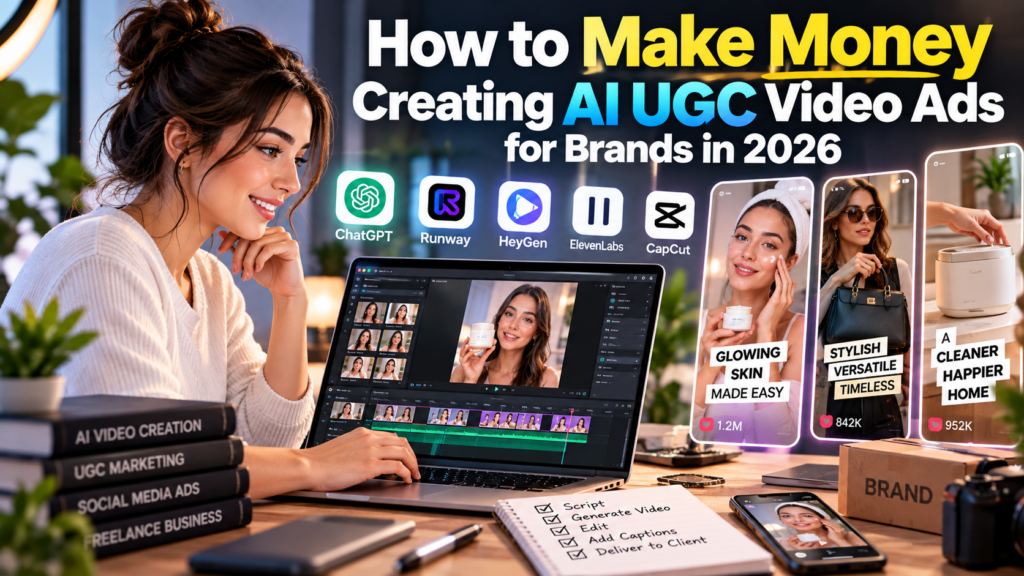
Creating short promotional videos used to require a camera, a presenter, lighting equipment, editing software, and sometimes an entire production team. In 2026, artificial intelligence has changed how much of that work can be done.
Freelancers can now use AI video generators, synthetic presenters, voice tools, and editing software to produce creator-style advertisements without filming every scene themselves.
This has created a new service opportunity: AI UGC video production.
Brands need a steady supply of short videos for TikTok, Instagram Reels, YouTube Shorts, and paid advertising campaigns. Many small businesses cannot afford traditional video production for every product or campaign. Others have experimented with AI tools but lack the creative and editing skills to turn generated footage into effective advertisements.
That gap creates an opportunity for freelancers who can combine AI production tools with marketing judgment.
The important distinction is that businesses are not simply looking for someone who can generate a random AI video. They need someone who can produce advertising content that communicates a product’s value, attracts attention, and gives their marketing team creative assets to test.
This guide explains how to build an AI UGC video advertising service, choose the right tools, create a portfolio, set prices, find clients, and validate the business before investing heavily in software.
1. Why AI UGC Video Ads Are a Business Opportunity in 2026
UGC stands for user-generated content. In marketing, the term commonly describes content that resembles ordinary customer or creator content rather than a traditional polished commercial.
Typical UGC-style videos include:
- A person introducing a product.
- A creator demonstrating how something works.
- A short problem-and-solution presentation.
- A product unboxing.
- A demonstration of product features.
- A direct-response advertisement with a clear call to action.
AI UGC uses artificial intelligence to create some or all of these elements. A synthetic presenter might introduce a product, AI-generated scenes might demonstrate its use, and editing software can combine the footage with captions, music, product images, and promotional messaging.
The commercial opportunity is supported by marketplace activity.
According to Fiverr’s September 2026 Business Trends Index, searches for AI UGC video ads increased by 265%, while searches for AI video ads increased by 63%. The report also identified a 278% increase in demand across its broader Video and Animation category.
These figures compare marketplace searches from November 2025 to April 2026 against May to October 2025.
Read Fiverr’s 2026 Business Trends Index for its methodology and findings.
Upwork also reported that AI UGC was its fastest-growing AI-related search in July 2026. Searches for AI video creators, AI video generation, and AI video ads showed increasing interest.
Read Upwork’s July 2026 Monthly Hiring Insights for more details.
These figures are encouraging, but they need to be interpreted correctly. Marketplace searches indicate interest in services, not guaranteed contracts or income. They also do not prove that every AI video freelancer will find paying customers.
The practical takeaway is that businesses are increasingly searching for specialized AI video production skills. Freelancers who can deliver finished advertising assets have a clearer commercial proposition than people simply selling access to AI tools.
2. What Exactly Is an AI UGC Video Ad?
An AI UGC video ad is a short promotional video that uses AI-generated or AI-assisted elements to imitate the presentation style of creator-led content.
A typical advertisement might look like this:
Example: Skincare product advertisement
A synthetic presenter appears on screen and introduces a skincare product. The video cuts to close-up product shots, animated text highlights the product’s features, and a voiceover explains the offer. The final scene displays the brand name and a call to action.
The video might be 20 to 30 seconds long and formatted vertically for mobile viewing.
A basic structure looks like this:
| Video section | Duration | Purpose |
|---|---|---|
| Hook | 0 to 3 seconds | Capture attention |
| Problem | 3 to 7 seconds | Identify a customer need |
| Product introduction | 7 to 13 seconds | Present the product |
| Benefits | 13 to 22 seconds | Explain supported product benefits |
| Call to action | 22 to 30 seconds | Encourage the next step |
You do not need to use an AI presenter in every advertisement. Some brands may prefer product-only demonstrations, animated scenes, voiceover videos, or hands-only product footage.
The objective is to produce a format that suits the brand, audience, and advertising campaign.
3. Choose a Profitable Niche Before Offering Your Service
One mistake beginners make is trying to create advertisements for every possible industry.
A better approach is to start with one or two product categories.
Specialization makes it easier to understand customer problems, write relevant scripts, develop reusable production templates, and demonstrate expertise.
Here are five potential niches.
Beauty and skincare
Potential video formats:
- Product demonstrations.
- Skincare routine videos.
- Texture and packaging close-ups.
- Product feature explanations.
- Short promotional offers.
Beauty brands frequently need visual content that demonstrates packaging, texture, and product presentation.
However, avoid unsupported claims about treating acne, reversing aging, or curing skin conditions.
Fashion and accessories
Potential video formats:
- Product showcases.
- Styling ideas.
- Bag and accessory demonstrations.
- Outfit combinations.
- Seasonal promotions.
Fashion and accessories are suitable for AI-assisted visual production, particularly when the brand can provide accurate product photography.
Home and lifestyle products
Potential video formats:
- Before-and-after demonstrations.
- Product use scenarios.
- Organization tips.
- Room styling.
- Feature comparisons.
This niche offers opportunities to combine generated environments with genuine product imagery.
Fitness and wellness
Potential video formats:
- Product introductions.
- Equipment demonstrations.
- Lifestyle advertisements.
- Feature explanations.
- Promotional videos.
This category requires additional care. Avoid fabricated customer results, unsupported health claims, and synthetic testimonials presented as genuine experiences.
Consumer electronics
Potential video formats:
- Feature demonstrations.
- Product close-ups.
- Accessory showcases.
- Comparison videos.
- Product launch announcements.
Electronics advertisements should accurately represent product appearance and functionality. AI-generated footage must not show features that the actual product does not have.
My recommendation: Start with beauty, fashion, or home products. These categories offer plenty of opportunities for visual storytelling, product demonstrations, and short-form promotional content.
4. The AI Tools You Need to Start
You do not need an expensive production setup to launch this service.
A practical workflow can use a small collection of tools.
| Production task | Example tools | What they do |
|---|---|---|
| Scriptwriting | ChatGPT, Claude | Generate hooks, scripts, and calls to action |
| AI video generation | Runway, Kling, Veo | Generate video scenes and product visuals |
| Synthetic presenters | HeyGen, Synthesia | Create presenter-led videos |
| Voiceovers | ElevenLabs | Generate synthetic voiceovers |
| Editing | CapCut, DaVinci Resolve | Assemble and refine video assets |
| Graphics | Canva | Create captions, overlays, and promotional graphics |
You do not need subscriptions to every platform. Choose tools based on the type of advertisements you intend to sell.
For example, a freelancer specializing in synthetic presenters may prioritize a presenter platform and editing software. Someone producing product-focused cinematic videos may prioritize AI video generation and image editing.
Before paying for a subscription, check:
- Commercial usage rights.
- Watermark restrictions.
- Export resolution.
- Video generation limits.
- Voice and avatar licensing.
- Restrictions on client advertising.
- Rules for using uploaded images and personal likenesses.
Tool pricing and licensing can change. Check the current terms before accepting paid client work.
5. How to Create an AI UGC Video Advertisement
A repeatable production process is more valuable than experimenting with different AI tools every day.
Here is a workflow you can use for a typical 20 to 30-second advertisement.
Step 1: Get the brand’s product information
Ask the client to provide:
- Product name.
- Product photographs.
- Target audience.
- Main product features.
- Price and promotional offer.
- Brand website.
- Preferred advertising platform.
- Required call to action.
- Brand guidelines.
You should also ask what claims the brand can substantiate.
Never invent product benefits simply because they make a script sound more persuasive.
Step 2: Develop the advertising concept
A video needs a clear idea before production begins.
For example, a brand selling a travel organizer might use this concept:
Hook: “Still struggling to keep your travel essentials organized?”
Problem: Show a disorganized suitcase.
Solution: Introduce the travel organizer.
Demonstration: Show how the compartments hold different items.
Call to action: “Explore the collection today.”
This is a straightforward problem-and-solution structure.
Develop two or three different hooks before producing the final video. Different openings can make the same product presentation feel substantially different.
Step 3: Write the script
Keep the script conversational.
A 20 to 30-second advertisement usually needs a concise message rather than a long product explanation.
Avoid making the synthetic presenter sound like a corporate spokesperson reading a press release.
Use natural language, short sentences, and a clear benefit.
A useful script formula is:
- Identify a relatable problem.
- Introduce the product.
- Explain one or two relevant features.
- Show the product in context.
- Give the viewer a next step.
Step 4: Generate the presenter or product scenes
Depending on the campaign, you can use:
- A licensed synthetic presenter.
- A product-focused AI scene.
- A generated lifestyle environment.
- Genuine product photographs animated into video.
- A combination of real footage and AI-generated elements.
For a product advertisement, accuracy is essential.
If the client provides a photograph of a handbag, for example, the AI-generated video should preserve the product’s recognizable design, color, proportions, and important details.
If the generated video repeatedly changes the product’s appearance, use genuine product footage or photographs instead.
A visually impressive advertisement that misrepresents the product is not a good commercial deliverable.
Step 5: Generate the voiceover
Select a voice that fits the brand’s target audience and communication style.
The voice should be clear, natural, and easy to understand on a mobile device.
Check pronunciation of brand names, product names, and technical terms.
Do not clone a real person’s voice without appropriate authorization.
Step 6: Edit the advertisement
This is where much of your value as a freelancer becomes visible.
Add:
- Accurate captions.
- Product images.
- Brand colors.
- Simple transitions.
- Background music with appropriate licensing.
- A clear opening hook.
- A visible call to action.
Remove unnecessary pauses and repetitive scenes.
The final video should communicate its message even when viewed without sound.
Step 7: Export and deliver
A practical default is a vertical 9:16 video for TikTok, Instagram Reels, and YouTube Shorts.
Confirm the client’s preferred resolution, file format, duration, and platform specifications before exporting.
Deliver the agreed files along with any additional versions included in the package.
6. Build a Portfolio Without Waiting for Your First Client
You do not need to convince a business to hire you before demonstrating your skills.
Create a small portfolio using sample advertisements for fictional brands or products you have permission to feature.
Start with three distinct examples:
Sample 1: Beauty product advertisement
Create a 20-second skincare product presentation with a synthetic presenter, product close-ups, captions, and a promotional call to action.
Sample 2: Fashion accessory advertisement
Create a short handbag showcase featuring lifestyle scenes, close-up product visuals, and styling suggestions.
Sample 3: Home product advertisement
Create a problem-and-solution video demonstrating how a fictional organization product can be used in a home environment.
Each sample should demonstrate a different creative approach.
Your portfolio should show:
- The finished video.
- The target audience.
- The advertising concept.
- The opening hook.
- The intended platform.
- The production format.
Clearly identify fictional demonstrations as portfolio samples. Do not imply that a real brand hired you or that an advertisement generated sales when it did not.
A simple portfolio can be hosted on a website, Google Drive, or a dedicated presentation page.
The purpose is to show prospective clients what they will receive.
7. How Much Should You Charge for AI UGC Videos?
Pricing depends on production complexity, quality, revisions, licensing, and the client’s intended usage.
A beginner should avoid competing exclusively on the lowest price. Producing an advertisement involves research, scripting, generation, editing, quality control, and client communication.
Here is an illustrative starting price structure.
| Package | Deliverables | Suggested price |
|---|---|---|
| Starter | 2 short video ads | $49 |
| Growth | 5 short video ads | $119 |
| Campaign | 10 short video ads | $219 |
| Monthly Creative | 12 short video ads | $249 |
These are suggested test prices, not established marketplace averages.
You can adjust them based on the complexity of the work and the type of client.
For example, a basic product video using client-supplied photographs may require less work than a campaign involving multiple synthetic presenters, custom scenes, several scripts, and different aspect ratios.
Your pricing agreement should specify:
- Video duration.
- Number of concepts.
- Number of revisions.
- Delivery timeline.
- Whether scripts are included.
- Whether source files are included.
- Commercial usage rights.
- Whether paid advertising usage is included.
- Whether the client can request new versions later.
Do not offer unlimited revisions. A client who changes the concept after approving the script should expect a new project scope or additional charge.
How to create recurring revenue
One-time orders are useful for acquiring clients, but monthly packages provide a more predictable business model.
For example, a small ecommerce brand may need four new advertisements every week.
You could offer a monthly service that includes:
- 12 short-form video advertisements.
- Three creative concepts.
- Multiple opening hooks.
- Caption and text overlays.
- Two rounds of revisions.
- Monthly delivery schedule.
The client gets a consistent supply of advertising creative, while you build a recurring service relationship.
However, do not promise a particular number of sales, leads, or advertising conversions unless you have a separate, properly measured performance agreement.
8. Where to Find Brands That Will Pay for AI UGC Ads
Your first clients are unlikely to arrive simply because you publish a portfolio.
You need a deliberate client acquisition strategy.
Upwork
Search for projects involving:
- AI UGC video.
- AI video advertisements.
- Short-form video editing.
- TikTok video ads.
- Product video creation.
- Social media advertisements.
Focus on clients who describe a specific production requirement rather than vague requests for someone to “make viral videos.”
A good proposal should link directly to a relevant portfolio sample and explain how you would deliver the requested work.
Visit Upwork to explore available freelance projects.
Fiverr
Create a focused service listing rather than advertising yourself as a general AI expert.
A possible title is:
“I will create AI UGC video ads for your ecommerce brand.”
Use portfolio examples that demonstrate different advertising styles.
Clearly explain the number of videos, duration, revisions, and commercial rights included.
Visit Fiverr to review its freelance service marketplace.
Direct outreach to ecommerce brands
This is worth testing because many small businesses have product pages and social accounts but limited video production resources.
Look for brands that:
- Sell visually interesting products.
- Already publish short-form videos.
- Have product photography available.
- Run active promotions.
- Have inconsistent video production.
- Could benefit from multiple creative variations.
Find their official business contact information and send a concise, relevant message.
Avoid mass messaging hundreds of businesses with identical generic pitches.
Social media
Use your own Instagram, TikTok, LinkedIn, or Facebook presence to demonstrate your production skills.
Publish short examples showing:
- The original product image.
- The creative concept.
- The final advertisement.
- Different opening hooks.
- Before-and-after editing improvements.
The portfolio itself becomes a demonstration of your service.
9. A Simple Client Outreach Message
Your first outreach message should be short and specific.
Instead of telling a business that AI will transform its marketing, explain what you can produce.
For example:
“Hi, I came across your product range and noticed an opportunity to create more short-form video advertisements for your products.
I create AI-assisted UGC-style video ads for ecommerce brands, including product demonstrations, creator-style presentations, captions, and promotional edits.
I would be happy to share a few relevant samples so you can see the production style.
Would you be open to taking a look?”
Personalize the opening sentence for each business. A relevant observation is more valuable than a generic compliment.
Do not produce unpaid custom campaigns for every prospect. A small public portfolio should be enough to establish your production capabilities.
10. Important Legal, Ethical, and Platform Considerations
AI-generated advertising introduces risks that freelancers should understand before accepting commercial projects.
Do not fabricate customer testimonials
A synthetic presenter can be used as a fictional spokesperson or an advertising character, but should not be presented as a real customer who personally used and experienced the product when that experience never happened.
The US Federal Trade Commission’s Consumer Reviews and Testimonials Rule prohibits certain fake or false reviews and testimonials, including testimonials that misrepresent whether someone exists or actually used a product.
The FTC also explains that AI-generated stock avatars are not categorically prohibited, but their use can still become deceptive depending on the claims and presentation.
Read the FTC’s guidance on consumer reviews and testimonials and its announcement of the rule.
Disclose synthetic content where required
Platform rules vary.
TikTok requires creators to label realistic AI-generated content and significantly AI-modified media in applicable circumstances. Its advertising policies also address AI-generated content and misleading representations.
Review TikTok’s AI-generated content guidelines and its advertising policy on misleading and false content before delivering campaign assets.
Respect likeness and voice rights
Do not use the face, voice, or identity of a real person without the appropriate authorization.
This includes celebrities, influencers, customers, and private individuals.
Use properly licensed synthetic presenters or obtain documented permission from anyone whose likeness appears in the advertisement.
Verify advertising claims
Never invent product results, customer experiences, scientific evidence, or performance statistics.
The FTC’s advertising guidance explains that advertising claims must be truthful, not misleading, and supported by appropriate evidence.
This is especially important for health, beauty, financial, and wellness products.
Read the FTC’s advertising and marketing guidance.
Clarify commercial usage rights
Check whether your AI tools allow commercial use of generated content and whether the client receives the rights they expect.
Your agreement should also address who owns the final deliverables, whether the client can modify them, and whether you can display the work in your portfolio.
The rules of the client’s target market and advertising platform may differ. Do not assume that compliance with one platform automatically satisfies every legal requirement.
11. How to Turn AI UGC Production Into a Real Business
A common mistake is treating every project as a completely new creative task.
That makes production slower and limits your ability to scale.
Instead, develop reusable systems.
Create reusable video templates
Build templates for:
- Product introductions.
- Problem-and-solution advertisements.
- Feature demonstrations.
- Promotional campaigns.
- Seasonal offers.
- Product comparisons.
Templates reduce repetitive editing while allowing each advertisement to retain its own creative direction.
Standardize client onboarding
Create a simple form that collects product information, brand assets, target audience, advertising objectives, and approved claims.
This reduces misunderstandings and unnecessary revisions.
Create a script approval process
Get approval for the concept and script before generating the final video.
This prevents expensive rework when a client changes the message after production.
Track production costs
Record:
- AI generation credits.
- Software subscriptions.
- Editing time.
- Revision time.
- Payment processing fees.
- Freelancer expenses.
A $100 order is not necessarily profitable if it takes eight hours to complete.
Your goal should be to improve production efficiency without sacrificing quality.
Build relationships with marketing agencies
Small marketing agencies may need additional creative production capacity.
You can offer white-label AI video production, where the agency handles the client relationship and you deliver the agreed video assets.
This can create recurring work, although wholesale pricing will generally be lower than direct client pricing.
12. A Seven-Day Plan to Validate Your AI UGC Business
Do not spend weeks building a website or purchasing expensive software before confirming that potential customers are interested.
Use this seven-day plan to test the business.
| Day | Action | Target output |
|---|---|---|
| 1 | Choose one niche and research 20 brands | Defined customer segment |
| 2 | Select one AI video workflow | Working production process |
| 3 | Produce a beauty or product sample | First portfolio video |
| 4 | Produce two more advertising samples | Three-video portfolio |
| 5 | Create a service page and packages | Clear commercial offer |
| 6 | Contact 15 relevant brands | Initial market feedback |
| 7 | Follow up and evaluate responses | Evidence for the next step |
At the end of the week, evaluate:
- How many businesses responded?
- Did anyone request pricing?
- Did anyone ask for a sample?
- Which niche generated the most interest?
- How long did each video take to produce?
- Could the service be delivered profitably?
A week without a sale does not necessarily disprove the business. However, repeated outreach with no meaningful interest should prompt you to reconsider the offer, target market, portfolio, or pricing.
The objective is to learn before investing more money.
13. How Much Could You Make?
Income depends on your ability to find clients, deliver consistent quality, manage production costs, and retain customers.
Consider three hypothetical monthly scenarios:
| Scenario | Monthly clients | Average monthly order | Gross revenue |
|---|---|---|---|
| Early stage | 2 | $119 | $238 |
| Developing | 5 | $249 | $1,245 |
| Established | 10 | $349 | $3,490 |
These are illustrative business scenarios, not earnings forecasts or typical freelancer results.
They also represent gross revenue before software, taxes, payment fees, labor, and other expenses.
The most important variable is not how many AI videos you can generate. It is how many paying clients you can acquire and retain while maintaining acceptable profit margins.
A freelancer who produces 30 videos for one recurring client may have a more sustainable business than someone who constantly searches for dozens of small one-time orders.
Final Thoughts: Sell Advertising Creative, Not AI Videos
AI UGC video production is a practical service opportunity in 2026 because businesses are showing increasing interest in AI-assisted video advertising.
Marketplace data from Fiverr and Upwork provides evidence of this demand, particularly for specialized production skills.
However, the technology itself is not a competitive advantage for long. More people will gain access to AI video generators, and basic video generation will become easier.
Your real value will come from understanding advertising, developing strong concepts, writing effective scripts, maintaining product accuracy, editing professionally, and delivering assets that brands can actually use.
Start with one niche, create three strong portfolio examples, offer a clearly defined service, and contact potential clients directly.
Do not build a complicated agency before securing your first paying customer.
The opportunity is not to become another person generating AI videos. It is to become a reliable creative production partner for brands that need better advertising content.
Explore more business opportunities and practical guides in the Make Money With AI category on AccessioDocs.
Share this article