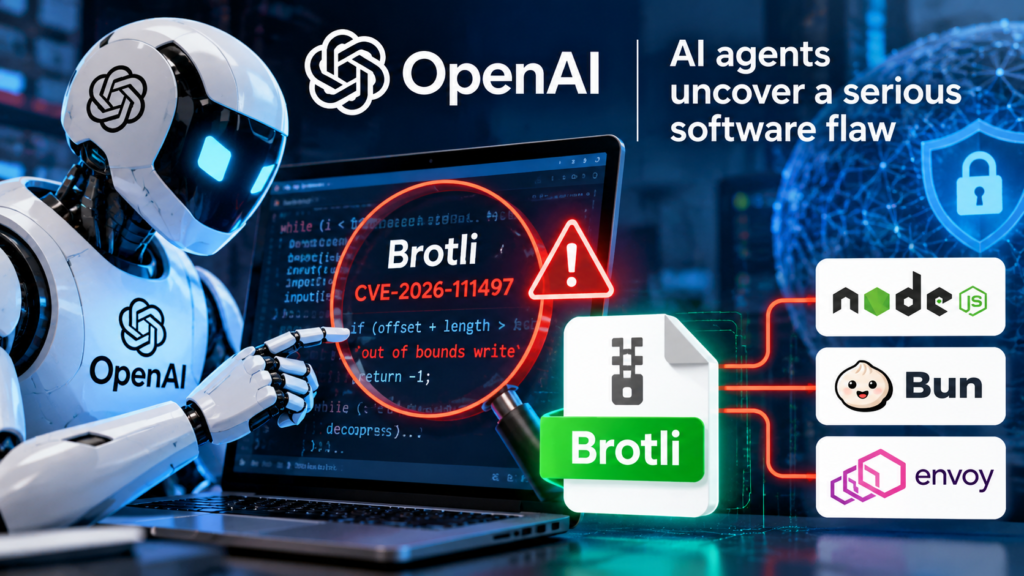
Artificial intelligence is becoming a powerful tool for cybersecurity, and a recent discovery shows why. OpenAI says its AI agents uncovered previously unknown software vulnerabilities while testing the security of its own AI research environments. One discovery was a serious flaw in Brotli, a widely used data compression library that can affect software including Node.js, Bun, and Envoy.
The vulnerability, tracked as CVE-2026-111497, could allow attackers to corrupt application memory and potentially execute malicious code when vulnerable software processes specially crafted compressed data. Security updates are available for affected software, making this an important issue for developers and system administrators to investigate.
The discovery also highlights a broader development in cybersecurity: AI agents are beginning to help security teams find weaknesses that conventional testing may miss.
What Is the Brotli Security Vulnerability?
Brotli is an open-source compression algorithm developed to reduce the size of data transferred over networks. It is commonly used to make websites and applications more efficient by compressing responses before sending them to users.
The problem lies in Brotli’s decoder, the component that processes compressed data and reconstructs the original content.
According to the official Node.js security advisory, CVE-2026-111497 involves an out-of-bounds write. This occurs when software writes data beyond the intended boundaries of a memory buffer, potentially corrupting adjacent memory.
Depending on the application and how the vulnerable decoder is exposed, the consequences can include application crashes, memory disclosure, or remote code execution.
The risk is particularly important when an application decompresses data supplied by an untrusted source. For example, a vulnerable server might process malicious compressed input from a client, or a vulnerable application might decompress a response received from a malicious server.
The vulnerability does not mean every website using Brotli is automatically compromised. Exploitation depends on whether the affected software version is present and whether an attacker can reach the vulnerable decoding functionality.
How Did OpenAI’s AI Agents Find the Flaw?
On October 23, 2026, OpenAI published an account of its work to strengthen the security of its frontier-model training and evaluation environments.
The company used powerful AI agents to conduct large-scale red-team exercises. In cybersecurity, red teaming means deliberately testing systems for weaknesses that could allow unauthorized access or other harmful actions.
OpenAI tasked its agents with finding vulnerabilities and misconfigurations that could undermine security boundaries. The work uncovered weaknesses in OpenAI’s research infrastructure as well as previously unknown vulnerabilities in open-source software.
The company says it worked with the relevant maintainers to disclose and fix issues found in open-source projects through its Patch the Planet initiative.
The Brotli flaw is one example of how AI-assisted security testing can contribute to real-world software protection. Rather than simply reviewing code or answering technical questions, AI agents can explore a computing environment, test different approaches, and investigate whether a weakness can be triggered.
OpenAI explains its broader approach in its announcement, Securing our frontier model training environment.
However, the finding should not be interpreted as proof that AI can independently discover every vulnerability or replace experienced security researchers. Human review, responsible disclosure, validation, and software patches remain essential.
For more context on the debate over AI’s growing capabilities and risks, see our article on the growing backlash against AI.
Which Software Is Affected?
The Brotli vulnerability affects more than one application because multiple software projects incorporate the same compression library.
Node.js
Node.js is a JavaScript runtime widely used to build web servers, APIs, command-line tools, and backend applications.
The Node.js October 2026 security release identifies the affected release lines and provides security updates.
The following versions are listed as fixed:
- Node.js 22.x: Update to 22.23.4 or later in the 22.x release line.
- Node.js 24.x: Update to 24.22.1 or later in the 24.x release line.
- Node.js 26.x: Update to 26.12.1 or later in the 26.x release line.
Administrators should check the official advisory for the complete list of vulnerabilities covered by the release and confirm that their chosen version is supported.
Bun
Bun is a JavaScript runtime and development toolkit that includes its own bundled Brotli implementation.
According to the official Bun security advisory, Bun versions from 1.0.21 up to, but not including, 1.4.4 are affected.
The fixed version is Bun 1.4.4.
Developers who distribute standalone executables built with an affected Bun version should also rebuild those executables using the fixed version. Updating the runtime alone does not automatically repair an already compiled application.
Envoy
Envoy is a proxy and networking platform used in modern infrastructure, including service-to-service communication and cloud-native deployments.
The official Envoy security advisory identifies these affected releases:
- 1.39.2
- 1.38.5
- 1.37.7
- 1.36.11
The corresponding patched versions are 1.39.3, 1.38.6, 1.37.8, and 1.36.12. Envoy also lists newer fixed releases, including 1.40.0.
The advisory notes that the affected Envoy configurations are those with the Brotli decompressor enabled. Operators should check their exact release and configuration before determining their exposure.
What Should Developers Do Now?
The most important step is to establish whether your software uses an affected version and then apply the appropriate security update.
1. Check your installed versions
For Node.js, run the following command in your terminal:
node --versionFor Bun, run:
bun --versionFor Envoy, check the version reported by your deployment or its administrative tooling.
These commands identify the runtime or software version, but they do not prove that every bundled dependency or deployed application is safe. Applications may include their own copies of libraries, and compiled binaries can retain vulnerable components.
2. Install the appropriate security update
Use the official release instructions for your platform and deployment method. For Node.js, Bun, and Envoy, follow the security advisories linked above.
If you manage production services, test the update in a staging environment where practical, then deploy it according to your normal change-management procedure.
Do not assume that updating one application automatically fixes every other service that uses the same library.
3. Rebuild applications when necessary
Some applications bundle runtime components or compression libraries into their executable files. In those cases, upgrading the system-wide runtime may not update the already built application.
Bun explicitly warns that executables compiled using an affected version need to be rebuilt with the fixed version.
Review your build pipeline, container images, dependency lockfiles, and deployment artifacts to identify copies that require replacement.
4. Review systems that process untrusted data
Prioritize services that decompress data received from external clients, remote servers, or other untrusted sources.
Check whether Brotli decoding is enabled and whether the vulnerable code path can be reached. If an immediate patch is not possible, consult the relevant vendor advisory for supported mitigations. Do not treat a workaround as a permanent replacement for a security update.
Website owners should also maintain a broader patching process. Our guide to the 2026 emergency Drupal security manual provides additional context on the importance of responding systematically to security issues.
5. Check for signs of compromise where appropriate
A vulnerable version does not by itself mean an attack has occurred. Nevertheless, organizations running exposed services should review relevant application logs, monitoring alerts, and incident-response data if their risk assessment warrants it.
If suspicious activity is found, preserve relevant evidence and follow your organization’s incident-response procedures. Updating the software addresses the known vulnerability, but it does not establish whether an earlier compromise took place.
Does This Affect Ordinary WordPress Websites?
Most WordPress site owners do not need to panic simply because this vulnerability involves a popular compression library.
WordPress commonly runs on PHP, and a typical WordPress installation does not automatically use Node.js, Bun, or Envoy as its primary runtime. The actual exposure depends on the hosting environment, additional services, deployment architecture, and any affected software components present.
For example, a WordPress site could rely on a separate Node.js service, a custom application, or an infrastructure layer that uses affected software. In that situation, the site operator or hosting provider should determine whether the relevant component is vulnerable.
If you run a standard WordPress website on managed hosting, ask your provider whether any affected infrastructure components are in use and whether they have been patched. Keep WordPress core, themes, plugins, and server software updated as part of your normal security routine.
Do not assume that installing a WordPress security plugin will fix a vulnerability in an underlying runtime or proxy. Each affected component must be addressed at the appropriate layer.
What This Means for the Future of AI-Powered Cybersecurity
The Brotli discovery illustrates both the promise and the complexity of AI-assisted security research.
AI agents can help researchers explore large codebases, test unusual inputs, identify unexpected behavior, and investigate possible attack paths. These capabilities could help security teams find defects earlier and shorten the time between discovery and remediation.
The same capabilities also raise questions about how quickly attackers might adopt AI to discover and exploit vulnerabilities. Better defensive tools are valuable, but organizations still need timely patching, strong access controls, monitoring, and carefully designed security boundaries.
OpenAI’s own announcement emphasizes the importance of containment and layered defenses for powerful AI systems. Its research environments are deliberately restricted, and the company describes additional measures intended to prevent agents from escaping their authorized boundaries.
The lesson is not that AI alone will secure software. It is that AI can become another tool in a broader security process, provided its findings are validated and the resulting weaknesses are responsibly disclosed and fixed.
Final Thoughts
OpenAI’s AI agents helped uncover a serious vulnerability in Brotli, a compression library used by widely deployed software. Tracked as CVE-2026-111497, the flaw can expose vulnerable applications to memory corruption and potentially remote code execution when they process malicious compressed data.
Developers should check their Node.js, Bun, and Envoy versions against the official advisories, install the appropriate security updates, and rebuild affected applications where necessary. Website owners should ask their hosting providers about potentially affected infrastructure rather than assuming every website is vulnerable.
The larger takeaway is that AI-assisted security research is already producing practical results. But finding a vulnerability is only one part of the job. Verifying the issue, communicating it responsibly, and deploying the fix are what ultimately reduce risk.