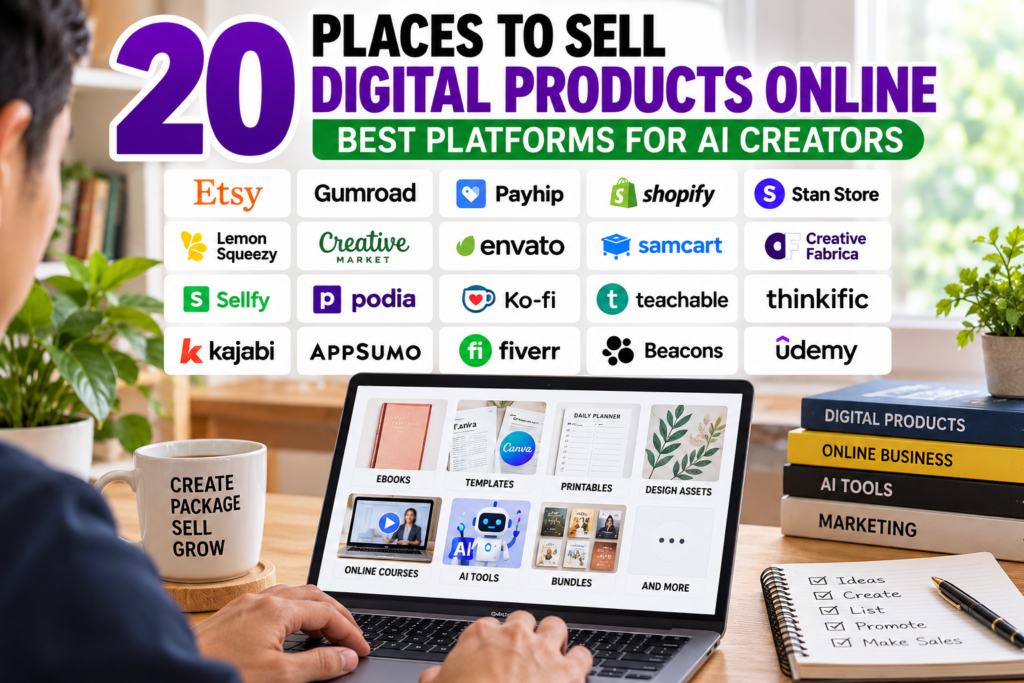
Selling digital products is one way to turn AI-assisted work into an online business. You can create ebooks, templates, printables, design assets, online courses, or specialized resources and sell them to customers around the world.
But choosing where to sell matters. Some platforms help shoppers discover products through a marketplace. Others provide a storefront for your existing audience. Some specialize in creative assets, software, online education, or freelance services.
This guide explores 20 platforms, links directly to each official website, and explains what each one is best suited for.
How to Choose the Right Platform
Before comparing the options, understand three important differences.
Marketplaces let customers discover products while searching or browsing. They can help sellers reach potential buyers, but competition and marketplace fees can affect profitability.
Digital storefronts provide product pages, checkout, and delivery. They work particularly well when you already attract visitors through social media, a blog, email, or YouTube.
Specialized platforms focus on particular business models, such as online courses, design assets, software, or freelance services.
The distinction matters because a platform that works well for a printable planner might be a poor choice for a professional training course. Your product, audience, budget, and preferred level of control should guide the decision.
20 Platforms to Sell Digital Products
1. Etsy
Best for: Printables, planners, templates, and digital artwork
Etsy is a marketplace where shoppers search for creative products. Sellers can offer downloadable planners, wall art, invitations, worksheets, printable decorations, and other original digital files.
Its main advantage is marketplace discovery. Potential customers may find your listing through Etsy search without visiting your website first.
Competition can be substantial, so product presentation, keyword research, listing quality, and differentiation matter. Etsy is worth exploring if you create visually appealing digital products for a clearly defined audience.
2. Gumroad
Best for: Ebooks, guides, templates, and creator products
Gumroad provides a relatively straightforward way to sell digital products directly to customers. Creators can offer downloadable files, educational resources, memberships, and other digital offerings.
It can work well for AI-assisted ebooks, prompt collections, productivity templates, and practical guides.
You can promote your product page through social accounts, newsletters, or a website. Gumroad also has a discovery feature, but its availability, fees, and sales potential should be checked before relying on it for customer acquisition.
3. Payhip
Best for: Ebooks, digital downloads, courses, and memberships
Payhip lets creators build a storefront and sell digital files, courses, and memberships. Its product delivery and marketing features make it useful for sellers who want a simple online business setup.
You can sell PDF guides, checklists, templates, educational resources, and downloadable bundles.
Payhip has offered a free plan with a transaction fee, alongside paid plans with different fee structures. Check its current pricing and plans before choosing.
Payhip is particularly worth considering if you already have an audience and want to direct customers to your own product page.
4. Shopify
Best for: Building a branded online store
Shopify is an ecommerce platform for businesses that want their own storefront, product catalog, checkout, and broader selling infrastructure.
It can support digital products through suitable apps and configurations. You can build a brand around multiple product categories, create landing pages, and combine digital goods with physical products.
The trade-off is cost and complexity. Subscriptions, payment processing, apps, and other operating expenses can add up.
Shopify makes more sense when you want to build a broader ecommerce business rather than simply list one ebook for sale.
5. Stan Store
Best for: Creators selling through social media
Stan Store is designed around creator-led commerce. It provides a storefront that can be linked from a social media profile, allowing followers to browse offers and purchase products.
Potential products include ebooks, downloadable templates, educational resources, and creator-led offers.
Its appeal is convenience: followers can move from your content to your product page without navigating a complex website.
A storefront does not automatically create demand, however. You still need content, audience trust, and a clear reason for people to buy. Review its current subscription plans before committing.
6. Lemon Squeezy
Best for: Software, digital tools, and subscriptions
Lemon Squeezy is an ecommerce platform with features for selling software, digital products, and subscriptions.
It can be relevant to creators selling software licenses, downloadable tools, premium templates, and other products that require recurring payments or international checkout.
Its merchant-of-record model can help with certain sales tax and VAT responsibilities, subject to its terms and supported transactions.
Before choosing it, check product eligibility, country support, payout availability, and current fees.
7. Creative Market
Best for: Fonts, graphics, templates, and design resources
Creative Market is a marketplace focused on creative assets. Its audience includes designers, marketers, and other professionals looking for resources they can use in their projects.
Potential products include original fonts, illustrations, graphic elements, presentation templates, and design assets.
This specialized audience may be a better fit for professional design resources than a general ebook store. However, marketplace standards, licensing requirements, competition, and seller revenue shares should be considered before investing heavily in product creation.
8. Envato Market
Best for: Professional creative and digital assets
Envato Market is a network of marketplaces for creative and digital resources. Depending on the relevant marketplace and its current rules, products may include website themes, graphics, video templates, audio assets, and other materials.
It is worth exploring if you have technical or creative skills and can produce assets that other professionals need.
This is not necessarily the easiest starting point for someone selling a general AI-generated ebook. Your product must fit the relevant marketplace, its submission requirements, and its licensing standards.
9. SamCart
Best for: Product checkout and sales funnels
SamCart focuses on checkout and sales optimization. It is useful for businesses that want to sell digital products through dedicated sales pages, checkout flows, and upsell offers.
For example, a creator could sell a starter guide, offer a larger bundle at checkout, and present a related course as a subsequent offer.
This approach can increase the value of each customer relationship, but it requires a coherent product ladder and enough traffic to justify the cost.
SamCart is more appropriate for sellers developing a structured sales funnel than for someone who simply needs a free place to upload a PDF.
10. Creative Fabrica
Best for: Craft designs, fonts, graphics, and printables
Creative Fabrica serves creative users looking for design resources, including fonts, illustrations, patterns, and craft-related assets.
It may be suitable for creators who produce original resources for crafters, hobbyists, designers, and small businesses.
Potential products include SVG files, printable designs, digital patterns, and compatible graphics.
As with other design marketplaces, review the platform’s current contributor rules, licensing terms, and commercial-use requirements. Products should be original or properly licensed, and buyers must understand what their purchases permit them to do.
11. Sellfy
Best for: Digital downloads and creator storefronts
Sellfy provides tools for creators who want to sell digital products through an online store. Depending on its current features and plan, sellers can build a storefront and offer downloadable resources alongside other product types.
Examples include ebooks, music, artwork, templates, and digital collections.
Sellfy may suit creators who want a more branded selling experience without assembling every ecommerce component themselves.
Compare its subscription costs with your expected sales. A monthly fee can be reasonable once sales become consistent, but it can be an unnecessary expense when demand is still uncertain.
12. Podia
Best for: Courses, digital downloads, and memberships
Podia combines digital product sales with features for online courses, memberships, and audience engagement.
It can be useful if your business goes beyond downloadable files. For example, you might sell an introductory ebook, a structured video course, and access to a paid learning community.
This combination can support a business in which customers progress from a low-cost resource to more comprehensive educational products.
Podia is worth considering when you want several parts of your digital business in one place. Check current plan limits, transaction fees, and payment options before signing up.
13. Ko-fi
Best for: Independent creators and small digital offers
Ko-fi offers creator-focused features, including ways to receive support and sell products. Its shop can be used for eligible digital downloads and other creator offerings.
Potential products include illustrations, printable resources, small ebooks, and downloadable collections.
It may be practical for creators who already have a community and want a simple destination for people who support their work.
Its effectiveness depends heavily on audience engagement. A shop link alone is unlikely to generate consistent sales if your content does not reach people who need the product.
14. Teachable
Best for: Structured online courses
Teachable focuses on selling educational products, including online courses and related learning offers.
It is more appropriate for a course with organized lessons, learning materials, and a defined educational outcome than for a single printable or short PDF.
For example, an AI creator could develop a course teaching small business owners how to build a content workflow, produce marketing materials, or use AI tools responsibly.
The key is to sell a transformation rather than merely a collection of files. Course production takes more work, so validate demand before building an extensive curriculum.
15. Thinkific
Best for: Online education and course businesses
Thinkific provides tools for building and delivering online learning experiences. It can support creators who want to organize lessons, deliver course materials, and manage students.
It is a potential fit for professional training, niche educational programs, and structured learning products.
An AI-assisted business could use it to offer a course on digital product creation, workflow automation, or a specialized professional skill.
Thinkific is not necessarily the cheapest choice for a beginner selling one ebook. Consider it when course delivery and the student experience are central to the business.
16. Kajabi
Best for: All-in-one knowledge businesses
Kajabi combines tools for online courses, memberships, marketing, and other parts of a knowledge-based business.
It may suit experienced creators who want to manage educational products and customer relationships through a more integrated system.
A business could combine a premium course, a membership, email marketing, and additional paid resources.
The main consideration is operating cost. An all-in-one platform can reduce the need to manage several separate tools, but the subscription only makes sense if its features support your business needs and revenue.
17. AppSumo
Best for: Software launches and promotional offers
AppSumo is known for promoting software and technology products, including limited-time deals. It is not a general-purpose storefront for every type of ebook or printable.
It may be relevant to software developers, SaaS founders, and businesses launching eligible digital tools.
An AI product might fit if it offers a clear utility, a differentiated feature set, and a sustainable support model.
Sellers should carefully examine application requirements, deal economics, customer expectations, and the implications of discounted or lifetime-access offers before pursuing this route.
18. Fiverr
Best for: AI-assisted freelance services
Fiverr is primarily a freelance services marketplace rather than a conventional digital-download storefront.
It can be useful if you want to earn money by providing services such as presentation design, video editing, copywriting, graphic design, or other deliverables that use AI as part of your workflow.
For example, you could offer to create a branded presentation or a batch of short-form video assets for a client.
The business model is different from selling an ebook repeatedly. You are selling a service and its deliverables, so consider your production time, revisions, platform fees, and service quality.
19. Beacons
Best for: Social media creators and link-in-bio selling
Beacons provides creator-focused tools, including link-in-bio pages and commerce features.
It can help creators organize links to their products, content, and other offers in one destination. Depending on its current features and plan, it may also support selling digital products.
This can be useful when your main source of traffic is Instagram, TikTok, YouTube, or another social channel.
A Beacons page is most effective when your content attracts a relevant audience and your offer is easy to understand. Review the current transaction fees and available features before selecting a plan.
20. Udemy
Best for: Recorded educational courses
Udemy is an online learning marketplace where instructors can publish courses for students.
It is worth considering if you can teach a valuable skill through structured video lessons, demonstrations, exercises, and other learning materials.
AI-related topics could include productivity workflows, design techniques, or practical tutorials for specific tools, provided the course is accurate and follows the platform’s requirements.
Udemy differs from a direct storefront because the course operates within a learning marketplace. Instructors should review its current revenue-sharing rules, promotional policies, and course requirements before investing in production.
Which Platform Should You Choose?
The most useful way to compare these 20 platforms is to match them to the product you want to sell.
| Your product or business | Platforms to explore |
|---|---|
| Printables, planners, and worksheets | Etsy, Payhip, Gumroad |
| Ebooks and downloadable guides | Payhip, Gumroad, Sellfy |
| Fonts, graphics, and design assets | Creative Market, Creative Fabrica, Envato Market |
| A branded ecommerce store | Shopify, Sellfy |
| Products sold through social media | Stan Store, Beacons, Ko-fi |
| Online courses | Teachable, Thinkific, Kajabi, Udemy, Podia |
| Software and digital tools | Lemon Squeezy, AppSumo |
| Checkout funnels and upsells | SamCart |
| Freelance services using AI | Fiverr |
| Courses, downloads, and memberships in one system | Podia, Kajabi, Thinkific |
These are starting points, not guarantees of acceptance or sales. Each platform has its own eligibility rules, payment options, fees, and audience characteristics.
For a broader comparison of how marketplaces, storefronts, and course platforms differ, see Shopify’s guide to selling digital products.
How to Make Money With AI on These Platforms
Choosing a platform is only one part of building a digital product business. You also need a product that solves a real problem and a way to reach people willing to pay for it.
Step 1: Choose a Specific Customer Problem
Start with a clear audience rather than a broad idea such as “AI products.”
For example, you could help small business owners produce social media content, help students organize study materials, or help independent creators develop better digital workflows.
A narrow problem makes it easier to define your product and explain why it is valuable.
Step 2: Use AI to Support Product Creation
AI tools can help with brainstorming, outlining, drafting, editing, design concepts, and workflow development.
Potential products include:
- Original ebooks and practical guides
- Budgeting or productivity templates
- Social media content planners
- Educational worksheets
- Business checklists and operating procedures
- Specialized digital resource bundles
Human review remains important. Verify factual claims, check calculations, test templates, and make sure you have the necessary rights to use any included assets.
If you want to explore a video-based business model, read How to Make Money With AI Videos on YouTube: A Real Case Study. It examines a reported case and explains why individual results should not be treated as a guaranteed income forecast.
Step 3: Select a Platform That Fits Your Traffic
If you do not have an established audience, a marketplace may offer opportunities for discovery. If you already have followers, a direct storefront can provide a simple destination for product links.
For creators developing original designs or downloadable resources, How to Make Money With AI by Selling Digital Products: A Real Etsy Case Study provides another example of this business model. Reported sales figures are not the same as profit, and a case study cannot predict what another seller will earn.
If your product involves AI-generated video or creative production, How to Make Money With Higgsfield AI: 2 Real Business Cases and 3 Ways to Start explores a different route: selling services or building commercial creative projects rather than relying exclusively on downloadable files.
Step 4: Validate Demand Before Building a Large Catalog
Create one useful product first. Publish a clear listing, show examples of what customers receive, and promote it to a relevant audience.
Track visits, conversion rate, customer questions, refunds, and net revenue after fees. Those metrics help you decide whether to improve the offer, adjust pricing, or develop another product.
Avoid creating dozens of products simply because AI makes production faster. A smaller catalog of useful, well-presented products can be a better starting point than a large collection with no clear audience.
Step 5: Calculate Profit, Not Just Sales
A product that sells for $20 does not generate $20 in profit. Consider platform fees, payment processing, subscriptions, advertising, refunds, taxes, and the time required to produce and maintain the product.
Also check whether the platform supports payouts in your country and which payment methods your customers can use.
Compare the total cost of each option before committing to a paid subscription.
Common Mistakes to Avoid
Choosing a platform only because it is popular. A marketplace for design assets may be unsuitable for a general business ebook, while a course platform may be excessive for one downloadable checklist.
Assuming a listing will generate traffic. Many storefronts provide checkout and delivery but expect sellers to attract customers themselves.
Ignoring fees and payout requirements. A platform that looks inexpensive can become less attractive once processing costs, subscriptions, currency conversion, and other charges are included.
Publishing low-value AI-generated content. Customers pay for usefulness, clarity, originality, and reliable results—not simply for the fact that AI was used.
Depending on a single sales channel. Where practical, build an independent audience through a website, email list, or consistent content strategy while following the rules of each marketplace.
Final Thoughts
There is no single best platform for every digital product business. Etsy and Creative Market may be suitable for marketplace discovery, Payhip and Gumroad can work for downloadable products, course platforms serve structured education, and Fiverr is better suited to selling services.
For beginners, the practical starting point is to select one product, one target audience, and one suitable platform. Validate demand before adding more tools or subscriptions.
AI can help you create and improve products more efficiently, but sustainable income still depends on solving a real problem, reaching the right customers, and managing the business carefully.
Share this article