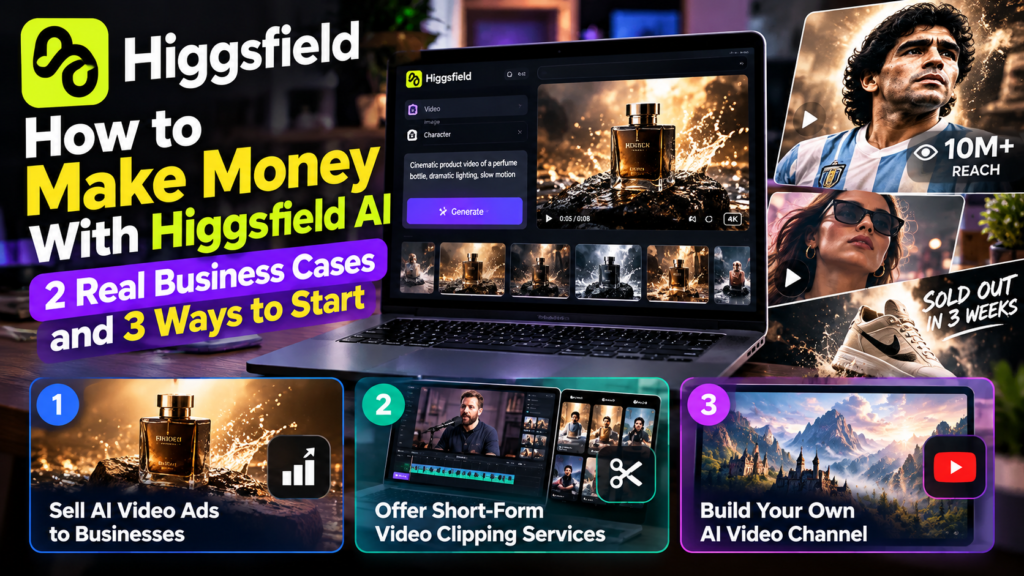
AI video generation is creating new opportunities for freelancers, content creators, and small businesses. Tasks that once required cameras, actors, locations, and production teams can now be approached with AI tools that generate cinematic scenes, product visuals, and advertising concepts.
One platform attracting attention is Higgsfield AI. It brings multiple AI image and video models into a creative workflow, allowing users to produce and refine visual content without switching between as many separate tools.
But can you actually make money with it?
The strongest evidence comes from businesses using AI video to produce commercial campaigns, not from claims that generating a few videos automatically creates passive income.
This guide examines two real business cases involving Higgsfield, explains three ways beginners could use similar workflows, and outlines how to test the opportunity without spending too much upfront.
What Is Higgsfield AI, and How Does It Work?
Higgsfield is an AI-powered visual creation platform designed for generating images, videos, and advertising content. Depending on the model and workflow, users can create cinematic sequences, animate images, change visual settings, and develop variations of marketing assets.
You can explore its capabilities on the official Higgsfield website.
Higgsfield also supports integrations with AI assistants. Its official MCP integration guide explains how users can connect the platform to Claude and other MCP-compatible agents to generate images, videos, characters, and audio from a conversation.
This means an AI assistant can help organize a creative brief, develop prompts, and request generations through the connected service. The assistant does not eliminate the need to review the output, select suitable footage, edit the final video, or manage the business.
For example, a business owner could describe a product advertisement, develop a storyboard with an AI assistant, generate visual scenes through Higgsfield, and assemble the best results into a finished campaign.
The commercial opportunity comes from delivering something a customer values, not merely from having access to the software.
Case Study 1: One of One Studios Creates an AI-Powered Maradona Campaign
One of the clearest commercial examples comes from One of One Studios, a creative studio that used Higgsfield to help produce an advertisement for apparel honoring football legend Diego Maradona.
According to a September 2026 report by Inc., the campaign featured an AI-generated likeness of Maradona, created with permission. The advertisement reached more than 10 million people on social media, and the associated collection reportedly sold out in three weeks, according to Higgsfield.
You can read the details in Inc.’s report on Higgsfield and the businesses using it.
The reported outcome is commercially interesting, but the limitations matter. The reach and sellout figures were attributed to Higgsfield, and the report does not disclose the campaign’s profit, production budget, or exact return on investment.
It is therefore evidence of a commercial AI video campaign, not proof that a beginner can reproduce the same results.
What can a beginner learn from this case?
The studio did not simply generate a random cinematic clip and hope it went viral. It created advertising around a specific product and worked with rights holders to use a recognizable public figure’s likeness appropriately.
That suggests three lessons.
First, sell a business outcome. Brands generally need advertising that attracts attention, communicates a product’s value, or supports a campaign. A compelling video is a means to that end.
Second, creative direction still matters. A good campaign needs a concept, a coherent visual style, suitable scenes, and a clear connection between the story and the product.
Third, rights and permissions are part of production. Do not assume you can commercially use a celebrity’s likeness, a competitor’s footage, a copyrighted character, or a brand’s assets simply because an AI tool can reproduce them.
For a freelancer, the practical takeaway is to begin with a simple product or service advertisement for a client who has authorized the use of the relevant brand assets.
Case Study 2: Levitate Foundry Uses Higgsfield to Produce Advertising at Scale
A second example involves Levitate Foundry, an advertising agency working with direct-to-consumer brands and creator-owned businesses.
The same Inc. report describes the agency’s use of Higgsfield for producing and testing advertising creative. The agency estimated that it spent between $3,000 and $50,000 per month on Higgsfield credits, depending on usage.
Its founder, Stephanie Liu, estimated that this expenditure was around 10% of what it would cost to create an equivalent volume of content through conventional production.
These figures are the agency’s estimates reported by Inc. They do not represent a verified profit margin or a guarantee that AI production will cost 90% less for every project.
The business model is nevertheless worth understanding.
Traditional advertising production can involve photographers, actors, studios, locations, lighting, travel, and repeated shoots. AI-assisted production can reduce the need to recreate certain scenes physically and make it easier to test multiple visual approaches.
For a brand that needs a steady stream of advertising variations, the value may come from producing and testing more creative concepts within a fixed budget.
What can a beginner learn from this case?
The opportunity is not necessarily to compete with a large agency immediately. It is to start with a narrower service.
For example, you could offer a small business:
- One short AI-assisted product advertisement.
- Three alternative opening hooks for testing.
- Several versions of the same campaign for different audiences.
- A package of vertical videos for social media.
The client is paying for the finished deliverables and the time saved, not for the number of prompts you submit.
The agency case also highlights an important cost consideration: AI video generation is not free at commercial scale. Credits, failed generations, editing time, revisions, and client communication all affect profitability.
Three Ways to Make Money With Higgsfield AI
The two cases demonstrate commercial applications of AI video. Here are three business models beginners can test, starting with the one that does not require building their own audience first.
1. Sell AI Video Ads to Businesses
<AsyncImage query=”premium cinematic product advertisement for skincare bottle on dramatic studio set commercial video production” aspectRatio=”16:9″ width=”100%” radius=”lg” />
This is the closest model to the One of One Studios and Levitate Foundry examples.
Potential customers include online stores, beauty brands, food businesses, clothing sellers, local service providers, and small companies that need more video content for social media.
You could use Higgsfield to create product scenes, cinematic backgrounds, visual transitions, and advertising variations. An editing tool can then combine those assets with captions, branding, sound, and a call to action.
A practical workflow looks like this:
- Choose a specific customer segment, such as online skincare stores.
- Create two or three original demonstration ads using products you have permission to feature.
- Build a small portfolio showing different styles and concepts.
- Contact relevant businesses with a specific proposal rather than a generic message offering AI videos.
- Agree on deliverables, revisions, usage rights, deadlines, and payment before production.
For an initial offer, you might sell a package of three short advertisements rather than an open-ended production service.
How to price the service
Do not price solely according to the length of the finished video. Account for generation credits, editing, revisions, communication, and the value of the deliverable.
For illustration, if you charge $150 for a package and spend $20 on generation credits and $10 on other direct costs, $120 remains before your labor, overhead, taxes, and any additional expenses.
That is an example calculation, not a market-rate recommendation or an earnings forecast.
The objective is to discover whether customers will pay enough to make the service worthwhile.
2. Offer Short-Form Video Clipping and Repurposing
<AsyncImage query=”vertical social media video editor laptop showing podcast clip timeline subtitles and multiple short video frames” aspectRatio=”16:9″ width=”100%” radius=”lg” />
Businesses, podcasters, educators, and creators often have long videos that could be repurposed into short clips.
A clipping service can identify strong moments, create vertical edits, add captions, improve pacing, and prepare the clips for publication on platforms such as YouTube Shorts, Instagram Reels, and TikTok.
Higgsfield may be useful when a project also needs generated cutaway scenes, illustrative visuals, or additional creative elements. However, ordinary clipping does not necessarily require AI video generation. Choose tools according to the job rather than adding unnecessary costs.
A possible service package could include:
- Four to eight short clips from one authorized source video.
- Captions and basic visual editing.
- Alternative hooks or opening sequences.
- Exported versions in the formats agreed with the client.
The main value is helping a customer turn existing content into more usable marketing assets.
Before accepting a project, confirm that the client has the necessary rights to the source material, music, and any third-party footage. Avoid reposting other creators’ videos without permission.
You should also distinguish between selling a clipping service to a client and monetizing those clips on your own channel. They have different business models and different risks.
3. Build Your Own Original AI-Assisted Video Channel
<AsyncImage query=”cinematic AI generated fantasy landscape vertical short video creator editing workstation with phone” aspectRatio=”16:9″ width=”100%” radius=”lg” />
The third option is to create your own channel and build an audience around an original content concept.
Potential niches include educational storytelling, science explanations, fictional worlds, historical reconstructions, technology explainers, and visual product demonstrations.
Higgsfield can help produce scenes that would be difficult or expensive to film. A conversational AI assistant can help research topics, structure scripts, and plan shots. You still need to verify factual claims, develop a distinctive format, and edit the results into a coherent story.
The main advantage is ownership of the channel and the opportunity to build a long-term audience. The disadvantage is that revenue may take time, and many channels never qualify for monetization.
YouTube’s official Partner Program eligibility guidance explains the requirements for joining the program. Meeting a numerical threshold does not guarantee acceptance, and monetization policies still apply.
YouTube also reviews channels for original value and compliance with its channel monetization policies. Repetitive, mass-produced, or minimally transformed content can be ineligible, even when AI tools were used to create it.
If you want to explore this route further, read our guide to making money with AI videos on YouTube, which examines a reported channel revenue case, the Shorts workflow, and the limits of relying on advertising income.
A Fourth Revenue Opportunity: Combine Video With Digital Products
You do not necessarily need to choose between video production and selling digital products.
An AI-assisted video can introduce an audience to a related downloadable product, such as a planner, template, checklist, educational guide, or resource bundle.
For example, a creator who publishes educational videos could offer a companion workbook. A freelancer teaching business organization could sell spreadsheet templates. A niche content creator could build a downloadable guide around a topic that consistently attracts viewers.
This approach creates a potential connection between content and a product that the creator owns.
Our guide to making money with AI by selling digital products examines an Etsy seller’s reported sales and explains how AI can support product research, design, and listing creation.
Neither video views nor digital downloads guarantee sales. The product should solve a relevant problem, and the audience should have a clear reason to buy it.
How Much Does Higgsfield Cost?
Before choosing a business model, understand how the tool’s costs affect your margins.
Higgsfield uses subscription plans and credits for many generations. The amount consumed depends on the model, generation type, duration, resolution, and other settings.
Check the official Higgsfield pricing page for current plan details rather than relying on an old screenshot or a creator’s promotional video.
There is also an important distinction when using integrations. Higgsfield’s official MCP documentation explains that generations made through MCP deduct credits at standard rates. Unlimited access or free generations offered for certain models on the Higgsfield website do not automatically apply through MCP.
That matters if you plan to generate many clips through Claude or another connected AI assistant.
Calculate your production cost before selling
Suppose you sell a short video package for $150.
| Cost item | Illustrative amount |
|---|---|
| Higgsfield generation credits | $20 |
| Other direct production costs | $10 |
| Amount remaining before labor and overhead | $120 |
These are hypothetical figures, not a quotation for a particular Higgsfield plan or a claim about typical freelancer margins.
Your actual cost could be higher if you need many attempts to obtain usable footage or if the client requests several rounds of changes.
Track the cost of each project, including failed generations and your working hours. This will help you decide which types of videos are worth producing.
A 30-Day Plan to Test the Business
You do not need to purchase an expensive plan or build a full agency before validating the idea. Start with a small experiment.
Week 1: Choose One Business Model
Decide whether you want to sell advertising videos, offer clipping services, or build an original channel.
Research potential customers and examine the work they already publish. Identify a specific gap your service could fill.
Week 2: Produce a Small Portfolio
Create two or three demonstration videos using assets you have permission to use. Test the workflow from concept to final export, recording how many generations and how much editing time each video requires.
Avoid producing a large portfolio before you know which style customers value.
Week 3: Test Demand
If you chose a service business, approach a focused group of potential clients with a relevant sample and a clear offer.
If you chose your own channel, publish a small batch of original videos and monitor how viewers respond.
Do not confuse views or positive comments with confirmed willingness to pay. For a service business, actual client conversations and paid orders are stronger evidence of demand.
Week 4: Review the Numbers
Evaluate your results.
For a service, track responses, proposals, conversions, time per project, generation costs, and money collected.
For a channel, track audience retention, returning viewers, subscribers, and whether viewers respond to the content in meaningful ways.
Continue only if the results suggest a credible path to improvement. Change the offer, audience, or format when the evidence points to a problem.
Important Risks Before You Start
AI video tools can create impressive visuals, but commercial use still requires judgment.
Copyright and likeness rights: Do not assume you can use a celebrity, a brand, or someone else’s footage commercially without the necessary permissions.
Misleading advertising: Make sure product claims are accurate. AI-generated scenes should not misrepresent what a customer will actually receive.
Disclosure: Some advertising and social platforms require disclosure of realistic synthetic or altered content in certain circumstances. Review the applicable rules before publishing.
Platform monetization: AI-generated content is not automatically eligible for YouTube monetization. Originality, repetition, and the value provided to viewers matter.
Tool costs: Credits and subscriptions can consume the profit from small projects. Calculate your costs before promising a price to a client.
Client expectations: A generated video may require many attempts and manual editing. Set realistic delivery times and define the number of revisions in advance.
Final Verdict: Can You Make Money With Higgsfield AI?
Yes, Higgsfield can support commercially useful work. The two business cases discussed here show how creative studios and advertising agencies use AI video to develop campaigns and produce advertising assets at scale.
But they do not prove that every user can earn a particular amount, and neither case should be treated as a guaranteed income formula.
For beginners, the most direct experiment may be selling a narrowly defined video service to businesses. It allows you to test whether customers will pay for the finished work without waiting to build a large audience. Clipping services are another option, while building your own channel may be more attractive if you want to develop a long-term content asset.
Start small, track every cost, use assets legally, and prioritize the quality of the final deliverable.
The opportunity is not simply to generate AI videos. It is to use AI to solve a problem that someone is willing to pay you to solve.